Loading...
justfile
Original:🇺🇸 English
Translated
Use when writing Justfiles to understand the latest syntax, features, and best practices
8installs
Sourceiloveitaly/ai-skills
Added on
NPX Install
npx skill4agent add iloveitaly/ai-skills justfileTags
Translated version includes tags in frontmatterSKILL.md Content
View Translation Comparison →Writing Justfiles
The below readme is pulled from: https://github.com/casey/just/blob/master/README.md
It fully documents the Justfile syntax and system.
<h1 align=center><code>just</code></h1>
justThis readme is also available as a book. The
book reflects the latest release, whereas the
readme on GitHub
reflects latest master.
(中文文档在 这里,
快看过来!)
Commands, called recipes, are stored in a file called with syntax
inspired by :
justfilemake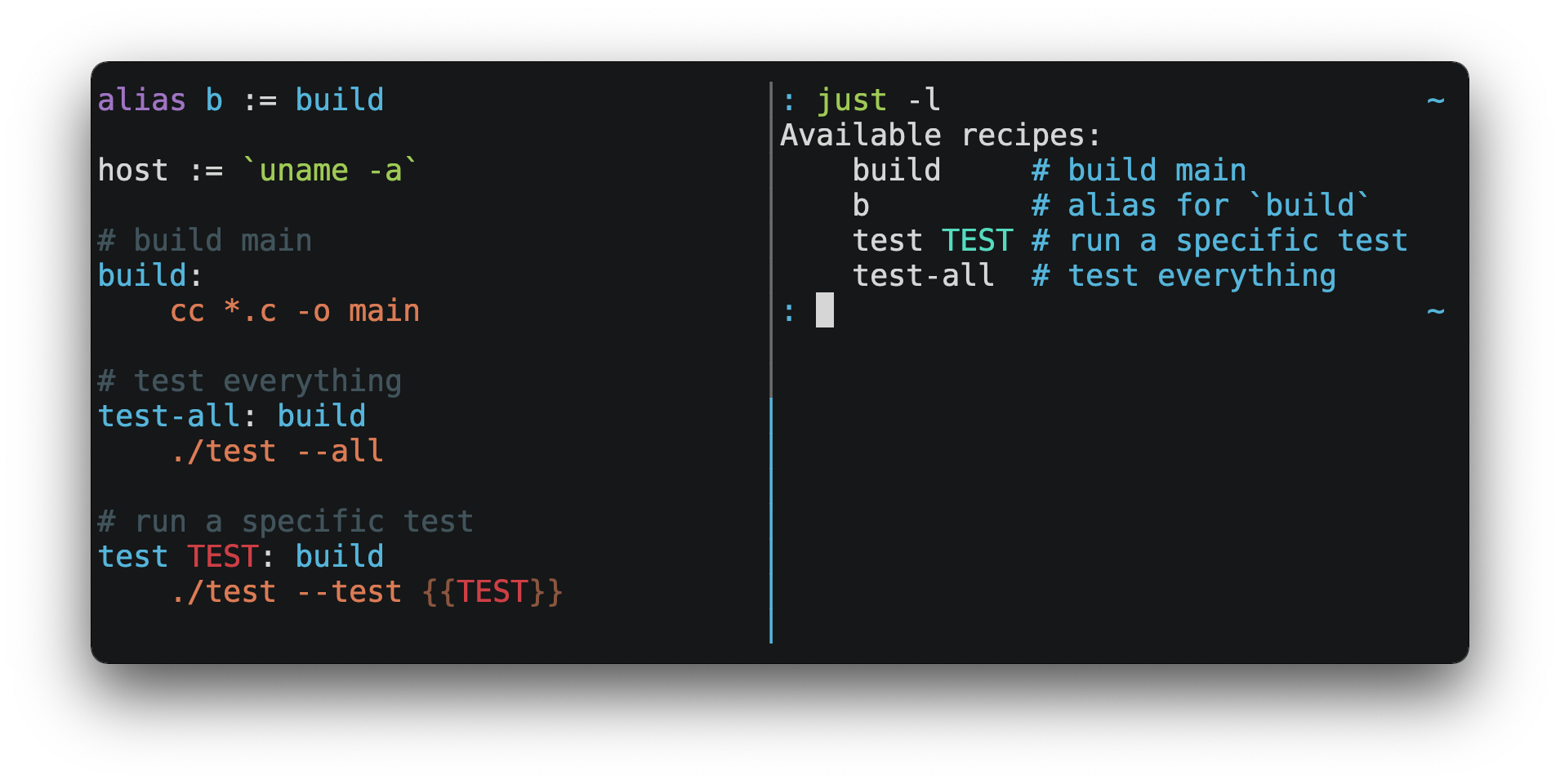
You can then run them with :
just RECIPEconsole
$ just test-all
cc *.c -o main
./test --all
Yay, all your tests passed!justmake- is a command runner, not a build system, so it avoids much of
just's complexity and idiosyncrasies. No need formakerecipes!.PHONY - Linux, MacOS, Windows, and other reasonable unices are supported with no
additional dependencies. (Although if your system doesn't have an , you'll need to choose a different shell.)
sh - Errors are specific and informative, and syntax errors are reported along with their source context.
- Recipes can accept command line arguments.
- Wherever possible, errors are resolved statically. Unknown recipes and circular dependencies are reported before anything runs.
- loads
justfiles, making it easy to populate environment variables..env - Recipes can be listed from the command line.
- Command line completion scripts are available for most popular shells.
- Recipes can be written in arbitrary languages, like Python or NodeJS.
- can be invoked from any subdirectory, not just the directory that contains the
just.justfile - And much more!
If you need help with please feel free to open an issue or ping me on
Discord. Feature requests and bug reports are
always welcome!
justQuick Start
See the installation section for how to install on your computer. Try
running to make sure that it's installed correctly.
justjust --versionFor an overview of the syntax, check out
this cheatsheet.
Once is installed and working, create a file named in the
root of your project with the following contents:
justjustfilejust
recipe-name:
  echo 'This is a recipe!'

# this is a comment
another-recipe:
  @echo 'This is another recipe.'
When you invoke it looks for file in the current directory
and upwards, so you can invoke it from any subdirectory of your project.
justjustfileThe search for a is case insensitive, so any case, like ,
, or , will work. will also look for files with the
name , in case you'd like to hide a .
justfileJustfileJUSTFILEJuStFiLejust.justfilejustfileRunning with no arguments runs the first recipe in the :
justjustfileconsole
$ just
echo 'This is a recipe!'
This is a recipe!
One or more arguments specify the recipe(s) to run:
console
$ just another-recipe
This is another recipe.justecho 'This is a recipe!'@echo 'This is another recipe.'Recipes stop running if a command fails. Here will only run if
succeeds:
cargo publishcargo testjust
publish:
  cargo test
  # tests passed, time to publish!
  cargo publish
Recipes can depend on other recipes. Here the recipe depends on the
recipe, so will run before :
testbuildbuildtestjust
build:
  cc main.c foo.c bar.c -o main

test: build
  ./test

sloc:
  @echo "`wc -l *.c` lines of code"
console
$ just test
cc main.c foo.c bar.c -o main
./test
testing… all tests passed!
Recipes without dependencies will run in the order they're given on the command
line:
console
$ just build sloc
cc main.c foo.c bar.c -o main
1337 lines of code
Dependencies will always run first, even if they are passed after a recipe that
depends on them:
console
$ just test build
cc main.c foo.c bar.c -o main
./test
testing… all tests passed!
Recipes may depend on recipes in submodules:
justfile
mod foo

baz: foo::bar
Examples
Features
The Default Recipe
When is invoked without a recipe, it runs the recipe with the
attribute, or the first recipe in the if no recipe has
the attribute.
just[default]justfile[default]This recipe might be the most frequently run command in the project, like
running the tests:
just
test:
  cargo test
You can also use dependencies to run multiple recipes by default:
just
default: lint build test

build:
  echo Building…

test:
  echo Testing…

lint:
  echo Linting…
If no recipe makes sense as the default recipe, you can add a recipe to the
beginning of your that lists the available recipes:
justfilejust
default:
  just --list
Listing Available Recipes
Recipes can be listed in alphabetical order with :
just --listconsole
$ just --list
Available recipes:
    build
    test
    deploy
    lint
Recipes in submodules can be listed with ,
where is a space- or -separated module path:
just --list PATHPATH::$ cat justfile
mod foo
$ cat foo.just
mod bar
$ cat bar.just
baz:
$ just --list foo bar
Available recipes:
baz
$ just --list foo::bar
Available recipes:
bazjust --summaryconsole
$ just --summary
build test deploy lint
Pass to print recipes in the order they appear in the :
--unsortedjustfilejust
test:
  echo 'Testing!'

build:
  echo 'Building!'
console
$ just --list --unsorted
Available recipes:
    test
    build
console
$ just --summary --unsorted
test build
If you'd like to default to listing the recipes in the , you
can use this as your default recipe:
justjustfilejust
default:
  @just --list
Note that you may need to add to the line above.
Without it, if you executed or
, the plain inside the recipe
would not necessarily use the file you provided. It would try to find a
justfile in your current path, maybe even resulting in a
error.
--justfile {{justfile()}}just -f /some/distant/justfile -d .just -f ./non-standard-justfilejust --listNo justfile foundThe heading text can be customized with :
--list-headingconsole
$ just --list --list-heading $'Cool stuff…\n'
Cool stuff…
    test
    build
And the indentation can be customized with :
--list-prefixconsole
$ just --list --list-prefix ····
Available recipes:
····test
····build
The argument to replaces both the heading and the newline
following it, so it should contain a newline if non-empty. It works this way so
you can suppress the heading line entirely by passing the empty string:
--list-headingconsole
$ just --list --list-heading ''
    test
    build
Invoking Multiple Recipes
Multiple recipes may be invoked on the command line at once:
just
build:
  make web

serve:
  python3 -m http.server -d out 8000
console
$ just build serve
make web
python3 -m http.server -d out 8000
Keep in mind that recipes with parameters will swallow arguments, even if they
match the names of other recipes:
just
build project:
  make {{project}}

serve:
  python3 -m http.server -d out 8000
console
$ just build serve
make: *** No rule to make target `serve'.  Stop.
The flag can be used to restrict command-line invocations to a single
recipe:
--oneconsole
$ just --one build serve
error: Expected 1 command-line recipe invocation but found 2.
Working Directory
By default, recipes run with the working directory set to the directory that
contains the .
justfileThe attribute can be used to make recipes run with the working
directory set to directory in which was invoked.
[no-cd]justjust
@foo:
  pwd

[no-cd]
@bar:
  pwd
console
$ cd subdir
$ just foo
/
$ just bar
/subdir
You can override the working directory for all recipes with
:
set working-directory := '…'just
set working-directory := 'bar'

@foo:
  pwd
console
$ pwd
/home/bob
$ just foo
/home/bob/bar
You can override the working directory for a specific recipe with the
attribute<sup>1.38.0</sup>:
working-directoryjust
[working-directory: 'bar']
@foo:
  pwd
console
$ pwd
/home/bob
$ just foo
/home/bob/bar
The argument to the setting or
attribute may be absolute or relative. If it is relative it is interpreted
relative to the default working directory.
working-directoryworking-directoryAliases
Aliases allow recipes to be invoked on the command line with alternative names:
just
alias b := build

build:
  echo 'Building!'
console
$ just b
echo 'Building!'
Building!
The target of an alias may be a recipe in a submodule:
justfile
mod foo

alias baz := foo::bar
Settings
Settings control interpretation and execution. Each setting may be specified at
most once, anywhere in the .
justfileFor example:
just
set shell := ["zsh", "-cu"]

foo:
  # this line will be run as `zsh -cu 'ls **/*.txt'`
  ls **/*.txt
Table of Settings
| Name | Value | Default | Description |
|---|---|---|---|
| boolean | | Allow recipes appearing later in a |
| boolean | | Allow variables appearing later in a |
| string | - | Load a |
| boolean | | Load a |
| boolean | | Override existing environment variables with values from the |
| string | - | Load a |
| boolean | | Error if a |
| boolean | | Export all variables as environment variables. |
| boolean | | Search |
| boolean | | Ignore recipe lines beginning with |
| boolean | | Pass positional arguments. |
| boolean | | Disable echoing recipe lines before executing. |
| | | Set command used to invoke recipes with empty |
| | - | Set command used to invoke recipes and evaluate backticks. |
| string | - | Create temporary directories in |
| boolean | | Enable unstable features. |
| boolean | | Use PowerShell on Windows as default shell. (Deprecated. Use |
| | - | Set the command used to invoke recipes and evaluate backticks. |
| string | - | Set the working directory for recipes and backticks, relative to the default working directory. |
Boolean settings can be written as:
justfile
set NAMEWhich is equivalent to:
justfile
set NAME := trueNon-boolean settings can be set to both strings and
expressions.<sup>1.46.0</sup>
However, because settings affect the behavior of backticks and many functions,
those expressions may not contain backticks or function calls, directly or
transitively via reference.
Allow Duplicate Recipes
If is set to , defining multiple recipes with
the same name is not an error and the last definition is used. Defaults to
.
allow-duplicate-recipestruefalsejust
set allow-duplicate-recipes

@foo:
  echo foo

@foo:
  echo bar
console
$ just foo
bar
Allow Duplicate Variables
If is set to , defining multiple variables
with the same name is not an error and the last definition is used. Defaults to
.
allow-duplicate-variablestruefalsejust
set allow-duplicate-variables

a := "foo"
a := "bar"

@foo:
  echo {{a}}
console
$ just foo
bar
Dotenv Settings
If any of , , , ,
or are set, will try to load environment variables
from a file.
dotenv-loaddotenv-filenamedotenv-overridedotenv-pathdotenv-requiredjustIf is set, will look for a file at the given path, which
may be absolute, or relative to the working directory.
dotenv-pathjustThe command-line option , short form , can be used to set or
override at runtime.
--dotenv-path-Edotenv-pathIf is set will look for a file at the given path,
relative to the working directory and each of its ancestors.
dotenv-filenamejustIf is not set, but or are
set, just will look for a file named , relative to the working directory
and each of its ancestors.
dotenv-filenamedotenv-loaddotenv-required.envdotenv-filenamedotenv-pathdotenv-pathdotenv-filenameIt is not an error if an environment file is not found, unless
is set.
dotenv-requiredThe loaded variables are environment variables, not variables, and so
must be accessed using in recipes and backticks.
just$VARIABLE_NAMEIf is set, variables from the environment file will override
existing environment variables.
dotenv-overrideFor example, if your file contains:
.envconsole
# a comment, will be ignored
DATABASE_ADDRESS=localhost:6379
SERVER_PORT=1337
And your contains:
justfilejust
set dotenv-load

serve:
  @echo "Starting server with database $DATABASE_ADDRESS on port $SERVER_PORT…"
  ./server --database $DATABASE_ADDRESS --port $SERVER_PORT
just serveconsole
$ just serve
Starting server with database localhost:6379 on port 1337…
./server --database $DATABASE_ADDRESS --port $SERVER_PORT
Export
The setting causes all variables to be exported as environment
variables. Defaults to .
exportjustfalsejust
set export

a := "hello"

@foo b:
  echo $a
  echo $b
console
$ just foo goodbye
hello
goodbye
Positional Arguments
If is , recipe arguments will be passed as
positional arguments to commands. For linewise recipes, argument will be
the name of the recipe.
positional-argumentstrue$0For example, running this recipe:
just
set positional-arguments

@foo bar:
  echo $0
  echo $1
Will produce the following output:
console
$ just foo hello
foo
hello
When using an -compatible shell, such as or , expands to
the positional arguments given to the recipe, starting from one. When used
within double quotes as , arguments including whitespace will be passed
on as if they were double-quoted. That is, is equivalent to …
When there are no positional parameters, and expand to nothing
(i.e., they are removed).
shbashzsh$@"$@""$@""$1" "$2""$@"$@This example recipe will print arguments one by one on separate lines:
just
set positional-arguments

@test *args='':
  bash -c 'while (( "$#" )); do echo - $1; shift; done' -- "$@"
Running it with two arguments:
console
$ just test foo "bar baz"
- foo
- bar baz
Positional arguments may also be turned on on a per-recipe basis with the
attribute<sup>1.29.0</sup>:
[positional-arguments]just
[positional-arguments]
@foo bar:
  echo $0
  echo $1
Note that PowerShell does not handle positional arguments in the same way as
other shells, so turning on positional arguments will likely break recipes that
use PowerShell.
If using PowerShell 7.4 or better, the flag will make
positional arguments work as expected:
-CommandWithArgsjust
set shell := ['pwsh.exe', '-CommandWithArgs']
set positional-arguments

print-args a b c:
  Write-Output @($args[1..($args.Count - 1)])
Shell
The setting controls the command used to invoke recipe lines and
backticks. Shebang recipes are unaffected. The default shell is .
shellsh -cujust
# use python3 to execute recipe lines and backticks
set shell := ["python3", "-c"]

# use print to capture result of evaluation
foos := `print("foo" * 4)`

foo:
  print("Snake snake snake snake.")
print("{{foos}}")just-cWindows Shell
justshwindows-shelljust
set windows-shell := ["powershell.exe", "-NoLogo", "-Command"]

hello:
  Write-Host "Hello, world!"
See
powershell.just
for a justfile that uses PowerShell on all platforms.
Windows PowerShell
set windows-powershellpowershell.exewindows-shelljustshpowershell.exewindows-powershelljust
set windows-powershell := true

hello:
  Write-Host "Hello, world!"
Python 3
just
set shell := ["python3", "-c"]Bash
just
set shell := ["bash", "-uc"]Z Shell
just
set shell := ["zsh", "-uc"]Fish
just
set shell := ["fish", "-c"]Nushell
just
set shell := ["nu", "-c"]If you want to change the default table mode to :
lightjust
set shell := ['nu', '-m', 'light', '-c']Nushell was written in Rust, and has
cross-platform support for Windows / macOS and Linux.
Documentation Comments
Comments immediately preceding a recipe will appear in :
just --listjust
# build stuff
build:
  ./bin/build

# test stuff
test:
  ./bin/test
console
$ just --list
Available recipes:
    build # build stuff
    test # test stuff
The attribute can be used to set or suppress a recipe's doc comment:
[doc]just
# This comment won't appear
[doc('Build stuff')]
build:
  ./bin/build

# This one won't either
[doc]
test:
  ./bin/test
console
$ just --list
Available recipes:
    build # Build stuff
    test
Expressions and Substitutions
Various operators and function calls are supported in expressions, which may be
used in assignments, default recipe arguments, and inside recipe body
substitutions.
{{…}}just
tmpdir  := `mktemp -d`
version := "0.2.7"
tardir  := tmpdir / "awesomesauce-" + version
tarball := tardir + ".tar.gz"
config  := quote(config_dir() / ".project-config")

publish:
  rm -f {{tarball}}
  mkdir {{tardir}}
  cp README.md *.c {{ config }} {{tardir}}
  tar zcvf {{tarball}} {{tardir}}
  scp {{tarball}} me@server.com:release/
  rm -rf {{tarball}} {{tardir}}
Concatenation
The operator returns the left-hand argument concatenated with the
right-hand argument:
+just
foobar := 'foo' + 'bar'Logical Operators
The logical operators and can be used to coalesce string
values<sup>1.37.0</sup>, similar to Python's and . These operators
consider the empty string to be false, and all other strings to be true.
&&||andor''These operators are currently unstable.
The operator returns the empty string if the left-hand argument is the
empty string, otherwise it returns the right-hand argument:
&&justfile
foo := '' && 'goodbye'      # ''
bar := 'hello' && 'goodbye' # 'goodbye'
The operator returns the left-hand argument if it is non-empty, otherwise
it returns the right-hand argument:
||justfile
foo := '' || 'goodbye'      # 'goodbye'
bar := 'hello' || 'goodbye' # 'hello'
Joining Paths
The operator can be used to join two strings with a slash:
/just
foo := "a" / "b"$ just --evaluate foo
a/bNote that a is added even if one is already present:
/just
foo := "a/"
bar := foo / "b"
$ just --evaluate bar
a//bAbsolute paths can also be constructed<sup>1.5.0</sup>:
just
foo := / "b"$ just --evaluate foo
/bThe operator uses the character, even on Windows. Thus, using the
operator should be avoided with paths that use universal naming convention
(UNC), i.e., those that start with , since forward slashes are not
supported with UNC paths.
///\?Escaping {{
{{To write a recipe containing , use :
{{{{{{just
braces:
  echo 'I {{{{LOVE}} curly braces!'
(An unmatched is ignored, so it doesn't need to be escaped.)
}}Another option is to put all the text you'd like to escape inside of an
interpolation:
just
braces:
  echo '{{'I {{LOVE}} curly braces!'}}'
Yet another option is to use :
{{ "{{" }}just
braces:
  echo 'I {{ "{{" }}LOVE}} curly braces!'
Strings
'single'"double"'''triple'''{{…}}Double-quoted strings support escape sequences:
just
carriage-return   := "\r"
double-quote      := "\""
newline           := "\n"
no-newline        := "\
"
slash             := "\\"
tab               := "\t"
unicode-codepoint := "\u{1F916}"
console
$ just --evaluate
"arriage-return   := "
double-quote      := """
newline           := "
"
no-newline        := ""
slash             := "\"
tab               := "     "
unicode-codepoint := "🤖"
The unicode character escape sequence <sup>1.36.0</sup> accepts up to
six hex digits.
\u{…}Strings may contain line breaks:
just
single := '
hello
'

double := "
goodbye
"
Single-quoted strings do not recognize escape sequences:
just
escapes := '\t\n\r\"\\'console
$ just --evaluate
escapes := "\t\n\r\"\\"
Indented versions of both single- and double-quoted strings, delimited by
triple single- or double-quotes, are supported. Indented string lines are
stripped of a leading line break, and leading whitespace common to all
non-blank lines:
just
# this string will evaluate to `foo\nbar\n`
x := '''
  foo
  bar
'''

# this string will evaluate to `abc\n  wuv\nxyz\n`
y := """
  abc
    wuv
  xyz
"""
Similar to unindented strings, indented double-quoted strings process escape
sequences, and indented single-quoted strings ignore escape sequences. Escape
sequence processing takes place after unindentation. The unindentation
algorithm does not take escape-sequence produced whitespace or newlines into
account.
Shell-expanded strings
Strings prefixed with are shell expanded<sup>1.27.0</sup>:
xjustfile
foobar := x'~/$FOO/${BAR}'| Value | Replacement |
|---|---|
| value of environment variable |
| value of environment variable |
| value of environment variable |
Leading | path to current user's home directory |
Leading | path to |
This expansion is performed at compile time, so variables from files and
exported variables cannot be used. However, this allows shell expanded
strings to be used in places like settings and import paths, which cannot
depend on variables and files.
.envjustjust.envFormat strings
Strings prefixed with are format strings<sup>1.44.0</sup>:
fjustfile
name := "world"
message := f'Hello, {{name}}!'
Format strings may contain interpolations delimited with that contain
expressions. Format strings evaluate to the concatenated string fragments and
evaluated expressions.
{{…}}Use to include a literal in a format string:
{{{{{{justfile
foo := f'I {{{{LOVE} curly braces!'Ignoring Errors
Normally, if a command returns a non-zero exit status, execution will stop. To
continue execution after a command, even if it fails, prefix the command with
:
-just
foo:
  -cat foo
  echo 'Done!'
console
$ just foo
cat foo
cat: foo: No such file or directory
echo 'Done!'
Done!
Functions
just{{…}}All functions ending in can be abbreviated to . So
can also be written as . In addition,
can be abbreviated to
.
_directory_dirhome_directory()home_dir()invocation_directory_native()invocation_dir_native()System Information
- — Instruction set architecture. Possible values are:
arch(),"aarch64","arm","asmjs","hexagon","mips","msp430","powerpc","powerpc64","s390x","sparc","wasm32","x86", and"x86_64"."xcore" - <sup>1.15.0</sup> - Number of logical CPUs.
num_cpus() - — Operating system. Possible values are:
os(),"android","bitrig","dragonfly","emscripten","freebsd","haiku","ios","linux","macos","netbsd","openbsd", and"solaris"."windows" - — Operating system family; possible values are:
os_family()and"unix"."windows"
For example:
just
system-info:
  @echo "This is an {{arch()}} machine".
console
$ just system-info
This is an x86_64 machine
The function can be used to create cross-platform s
that work on various operating systems. For an example, see
cross-platform.just
file.
os_family()justfileExternal Commands
-
<sup>1.27.0</sup> returns the standard output of shell script
shell(command, args...)with zero or more positional argumentscommand. The shell used to interpretargsis the same shell that is used to evaluate recipe lines, and can be changed withcommand.set shell := […]is passed as the first argument, so if the command iscommand, the full command line, with the default shell command'echo $@'andsh -cuargsand'foo'will be:'bar''sh' '-cu' 'echo $@' 'echo $@' 'foo' 'bar'This is so thatworks as expected, and$@refers to the first argument.$1does not include the first positional argument, which is expected to be the name of the program being run.$@
just
# arguments can be variables or expressions
file := '/sys/class/power_supply/BAT0/status'
bat0stat := shell('cat $1', file)

# commands can be variables or expressions
command := 'wc -l'
output := shell(command + ' "$1"', 'main.c')

# arguments referenced by the shell command must be used
empty := shell('echo', 'foo')
full := shell('echo $1', 'foo')
error := shell('echo $1')
just
# Using python as the shell. Since `python -c` sets `sys.argv[0]` to `'-c'`,
# the first "real" positional argument will be `sys.argv[2]`.
set shell := ["python3", "-c"]
olleh := shell('import sys; print(sys.argv[2][::-1])', 'hello')
Environment Variables
- <sup>1.15.0</sup> — Retrieves the environment variable with name
env(key), aborting if it is not present.key
just
home_dir := env('HOME')

test:
  echo "{{home_dir}}"
console
$ just
/home/user1- <sup>1.15.0</sup> — Retrieves the environment variable with name
env(key, default), returningkeyif it is not present.default - — Deprecated alias for
env_var(key).env(key) - — Deprecated alias for
env_var_or_default(key, default).env(key, default)
A default can be substituted for an empty environment variable value with the
operator, currently unstable:
||just
set unstable

foo := env('FOO', '') || 'DEFAULT_VALUE'
Executables
-
<sup>1.39.0</sup> — Search directories in the
require(name)environment variable for the executablePATHand return its full path, or halt with an error if no executable withnameexists.namejustbash := require("bash") @test: echo "bash: '{{bash}}'"console$ just bash: '/bin/bash' -
<sup>1.39.0</sup> — Search directories in the
which(name)environment variable for the executablePATHand return its full path, or the empty string if no executable withnameexists. Currently unstable.namejustset unstable bosh := which("bosh") @test: echo "bosh: '{{bosh}}'"console$ just bosh: ''
Invocation Information
- - Returns the string
is_dependency()if the current recipe is being run as a dependency of another recipe, rather than being run directly, otherwise returns the stringtrue.false
Invocation Directory
- - Retrieves the absolute path to the current directory when
invocation_directory()was invoked, beforejustchanged it (chdir'd) prior to executing commands. On Windows,justusesinvocation_directory()to convert the invocation directory to a Cygwin-compatiblecygpath-separated path. Use/to return the verbatim invocation directory on all platforms.invocation_directory_native()
For example, to call on files just under the "current directory"
(from the user/invoker's perspective), use the following rule:
rustfmtjust
rustfmt:
  find {{invocation_directory()}} -name \*.rs -exec rustfmt {} \;
Alternatively, if your command needs to be run from the current directory, you
could use (e.g.):
just
build:
cd {{invocation_directory()}}; ./some_script_that_needs_to_be_run_from_here- - Retrieves the absolute path to the current directory when
invocation_directory_native()was invoked, beforejustchanged it (chdir'd) prior to executing commands.just
Justfile and Justfile Directory
- - Retrieves the path of the current
justfile().justfile - - Retrieves the path of the parent directory of the current
justfile_directory().justfile
For example, to run a command relative to the location of the current
:
justfilejust
script:
  {{justfile_directory()}}/scripts/some_script
Source and Source Directory
- <sup>1.27.0</sup> - Retrieves the path of the current source file.
source_file() - <sup>1.27.0</sup> - Retrieves the path of the parent directory of the current source file.
source_directory()
source_file()source_directory()justfile()justfile_directory()justfileimportmodJust Executable
- - Absolute path to the
just_executable()executable.just
For example:
just
executable:
  @echo The executable is at: {{just_executable()}}
console
$ just
The executable is at: /bin/just
Just Process ID
- - Process ID of the
just_pid()executable.just
For example:
just
pid:
  @echo The process ID is: {{ just_pid() }}
console
$ just
The process ID is: 420
String Manipulation
- <sup>1.27.0</sup> Append
append(suffix, s)to whitespace-separated strings insuffix.s→append('/src', 'foo bar baz')'foo/src bar/src baz/src' - <sup>1.27.0</sup> Prepend
prepend(prefix, s)to whitespace-separated strings inprefix.s→prepend('src/', 'foo bar baz')'src/foo src/bar src/baz' - <sup>1.27.0</sup> - Percent-encode characters in
encode_uri_component(s)excepts, matching the behavior of the JavaScript[A-Za-z0-9_.!~*'()-]function.encodeURIComponent - - Replace all single quotes with
quote(s)and prepend and append single quotes to'\''. This is sufficient to escape special characters for many shells, including most Bourne shell descendants.s - - Replace all occurrences of
replace(s, from, to)infromtos.to - - Replace all occurrences of
replace_regex(s, regex, replacement)inregextos. Regular expressions are provided by the Rustreplacementcrate. See the syntax documentation for usage examples. Capture groups are supported. Theregexstring uses Replacement string syntax.replacement - - Remove leading and trailing whitespace from
trim(s).s - - Remove trailing whitespace from
trim_end(s).s - - Remove suffix of
trim_end_match(s, substring)matchings.substring - - Repeatedly remove suffixes of
trim_end_matches(s, substring)matchings.substring - - Remove leading whitespace from
trim_start(s).s - - Remove prefix of
trim_start_match(s, substring)matchings.substring - - Repeatedly remove prefixes of
trim_start_matches(s, substring)matchings.substring
Case Conversion
- <sup>1.7.0</sup> - Convert first character of
capitalize(s)to uppercase and the rest to lowercase.s - <sup>1.7.0</sup> - Convert
kebabcase(s)tos.kebab-case - <sup>1.7.0</sup> - Convert
lowercamelcase(s)tos.lowerCamelCase - - Convert
lowercase(s)to lowercase.s - <sup>1.7.0</sup> - Convert
shoutykebabcase(s)tos.SHOUTY-KEBAB-CASE - <sup>1.7.0</sup> - Convert
shoutysnakecase(s)tos.SHOUTY_SNAKE_CASE - <sup>1.7.0</sup> - Convert
snakecase(s)tos.snake_case - <sup>1.7.0</sup> - Convert
titlecase(s)tos.Title Case - <sup>1.7.0</sup> - Convert
uppercamelcase(s)tos.UpperCamelCase - - Convert
uppercase(s)to uppercase.s
Path Manipulation
Fallible
- - Absolute path to relative
absolute_path(path)in the working directory.pathin directoryabsolute_path("./bar.txt")is/foo./foo/bar.txt - <sup>1.24.0</sup> - Canonicalize
canonicalize(path)by resolving symlinks and removingpath,., and extra..s where possible./ - - Extension of
extension(path).pathisextension("/foo/bar.txt").txt - - File name of
file_name(path)with any leading directory components removed.pathisfile_name("/foo/bar.txt").bar.txt - - File name of
file_stem(path)without extension.pathisfile_stem("/foo/bar.txt").bar - - Parent directory of
parent_directory(path).pathisparent_directory("/foo/bar.txt")./foo - -
without_extension(path)without extension.pathiswithout_extension("/foo/bar.txt")./foo/bar
These functions can fail, for example if a path does not have an extension,
which will halt execution.
Infallible
- - Simplify
clean(path)by removing extra path separators, intermediatepathcomponents, and.where possible...isclean("foo//bar"),foo/barisclean("foo/.."),.isclean("foo/./bar").foo/bar - - This function uses
join(a, b…)on Unix and/on Windows, which can be lead to unwanted behavior. The\operator, e.g.,/, which always usesa / b, should be considered as a replacement unless/s are specifically desired on Windows. Join path\with patha.bisjoin("foo/bar", "baz"). Accepts two or more arguments.foo/bar/baz
Filesystem Access
- - Returns
path_exists(path)if the path points at an existing entity andtrueotherwise. Traverses symbolic links, and returnsfalseif the path is inaccessible or points to a broken symlink.false - <sup>1.39.0</sup> - Returns the content of file at
read(path)as string.path
Error Reporting
- - Abort execution and report error
error(message)to user.message
UUID and Hash Generation
- <sup>1.25.0</sup> - Return BLAKE3 hash of
blake3(string)as hexadecimal string.string - <sup>1.25.0</sup> - Return BLAKE3 hash of file at
blake3_file(path)as hexadecimal string.path - - Return the SHA-256 hash of
sha256(string)as hexadecimal string.string - - Return SHA-256 hash of file at
sha256_file(path)as hexadecimal string.path - - Generate a random version 4 UUID.
uuid()
Random
- <sup>1.27.0</sup> - Generate a string of
choose(n, alphabet)randomly selected characters fromn, which may not contain repeated characters. For example,alphabetwill generate a random 64-character lowercase hex string.choose('64', HEX)
Datetime
- <sup>1.30.0</sup> - Return local time with
datetime(format).format - <sup>1.30.0</sup> - Return UTC time with
datetime_utc(format).format
The arguments to and are -style format
strings, see the
library docs
for details.
datetimedatetime_utcstrftimechronoSemantic Versions
- <sup>1.16.0</sup> - Check whether a semantic
semver_matches(version, requirement), e.g.,versionmatches a"0.1.0", e.g.,requirement, returning">=0.1.0"if so and"true"otherwise."false"
Style
-
<sup>1.37.0</sup> - Return a named terminal display attribute escape sequence used by
style(name). Unlike terminal display attribute escape sequence constants, which contain standard colors and styles,justreturns an escape sequence used bystyle(name)itself, and can be used to make recipe output matchjust's own output.justRecognized values forarename, for echoed recipe lines,'command', anderror.warningFor example, to style an error message:justscary: @echo '{{ style("error") }}OH NO{{ NORMAL }}'
User Directories<sup>1.23.0</sup>
These functions return paths to user-specific directories for things like
configuration, data, caches, executables, and the user's home directory.
On Unix, these functions follow the
XDG Base Directory Specification.
On MacOS and Windows, these functions return the system-specified user-specific
directories. For example, returns on
MacOS and on Windows.
cache_directory()~/Library/Caches{FOLDERID_LocalAppData}See the crate for more
details.
dirs- - The user-specific cache directory.
cache_directory() - - The user-specific configuration directory.
config_directory() - - The local user-specific configuration directory.
config_local_directory() - - The user-specific data directory.
data_directory() - - The local user-specific data directory.
data_local_directory() - - The user-specific executable directory.
executable_directory() - - The user's home directory.
home_directory()
If you would like to use XDG base directories on all platforms you can use the
function with the appropriate environment variable and fallback,
although note that the XDG specification requires ignoring non-absolute paths,
so for full compatibility with spec-compliant applications, you would need to
do:
env(…)just
xdg_config_dir := if env('XDG_CONFIG_HOME', '') =~ '^/' {
  env('XDG_CONFIG_HOME')
} else {
  home_directory() / '.config'
}
Constants
A number of constants are predefined:
| Name | Value | Value on Windows |
|---|---|---|
| | |
| | |
| | |
| | |
| | |
| | |
| | |
| | |
| | |
| | |
| | |
| | |
| | |
| | |
| | |
| | |
| | |
| | |
| | |
| | |
| | |
| | |
| | |
| | |
| | |
| | |
| | |
| | |
| |
just
@foo:
  echo {{HEX}}
console
$ just foo
0123456789abcdef
Constants starting with are
ANSI escape sequences.
\eCLEARclear\e[NmNTerminal display attribute escape sequences can be combined, for example text
weight , text style , foreground color , and
background color . They should be followed by , to reset the
terminal back to normal.
BOLDSTRIKETHROUGHCYANBG_BLUENORMALEscape sequences should be quoted, since is treated as a special character
by some shells.
[just
@foo:
  echo '{{BOLD + STRIKETHROUGH + CYAN + BG_BLUE}}Hi!{{NORMAL}}'
Attributes
Recipes, statements, and aliases may be annotated with attributes that
change their behavior.
mod| Name | Type | Description |
|---|---|---|
| recipe | Print help string |
| recipe | Require values of argument |
| recipe | Require values of argument |
| recipe | Makes option |
| recipe | Require values of argument |
| recipe | Require confirmation prior to executing recipe. |
| recipe | Require confirmation prior to executing recipe with a custom prompt. |
| recipe | Use recipe as module's default recipe. |
| module, recipe | Set recipe or module's documentation comment to |
| recipe | Set shebang recipe script's file extension to |
| module, recipe | Put recipe or module in in group |
| recipe | Enable recipe on Linux. |
| recipe | Enable recipe on MacOS. |
| recipe | Attach |
| recipe | Don't change directory before executing recipe. |
| recipe | Don't print an error message if recipe fails. |
| recipe | Override globally quiet recipes and always echo out the recipe. |
| recipe | Enable recipe on OpenBSD. |
| recipe | Run this recipe's dependencies in parallel. |
| recipe | Turn on positional arguments for this recipe. |
| alias, recipe | Make recipe, alias, or variable private. See Private Recipes. |
| recipe | Execute recipe as script. See script recipes for more details. |
| recipe | Execute recipe as a script interpreted by |
| recipe | Enable recipe on Unixes. (Includes MacOS). |
| recipe | Enable recipe on Windows. |
| recipe | Set recipe working directory. |
A recipe can have multiple attributes, either on multiple lines:
just
[no-cd]
[private]
foo:
    echo "foo"
Or separated by commas on a single line<sup>1.14.0</sup>:
just
[no-cd, private]
foo:
    echo "foo"
Attributes with a single argument may be written with a colon:
just
[group: 'bar']
foo:
Enabling and Disabling Recipes<sup>1.8.0</sup>
The , , , and attributes are
configuration attributes. By default, recipes are always enabled. A recipe with
one or more configuration attributes will only be enabled when one or more of
those configurations is active.
[linux][macos][unix][windows]This can be used to write s that behave differently depending on
which operating system they run on. The recipe in this will
compile and run , using a different C compiler and using the correct
output binary name for that compiler depending on the operating system:
justfilerunjustfilemain.cjust
[unix]
run:
  cc main.c
  ./a.out

[windows]
run:
  cl main.c
  main.exe
Disabling Changing Directory<sup>1.9.0</sup>
justjustfile[no-cd]For example, this recipe:
commitjust
[no-cd]
commit file:
  git add {{file}}
  git commit
Can be used with paths that are relative to the current directory, because
prevents from changing the current directory when executing
.
[no-cd]justcommitRequiring Confirmation for Recipes<sup>1.17.0</sup>
just[confirm]--yesjustRecipes dependent on a recipe that requires confirmation will not be run if the
relied upon recipe is not confirmed, as well as recipes passed after any recipe
that requires confirmation.
just
[confirm]
delete-all:
  rm -rf *
Custom Confirmation Prompt<sup>1.23.0</sup>
The default confirmation prompt can be overridden with :
[confirm(PROMPT)]just
[confirm("Are you sure you want to delete everything?")]
delete-everything:
  rm -rf *
Groups
Recipes and modules may be annotated with one or more group names:
just
[group('lint')]
js-lint:
    echo 'Running JS linter…'

[group('rust recipes')]
[group('lint')]
rust-lint:
    echo 'Running Rust linter…'

[group('lint')]
cpp-lint:
  echo 'Running C++ linter…'

# not in any group
email-everyone:
    echo 'Sending mass email…'
Recipes are listed by group:
$ just --list
Available recipes:
    email-everyone # not in any group

    [lint]
    cpp-lint
    js-lint
    rust-lint

    [rust recipes]
    rust-lint
just --list --unsorted$ just --list --unsorted
Available recipes:
(no group)
email-everyone # not in any group
[lint]
js-lint
rust-lint
cpp-lint
[rust recipes]
rust-lintGroups can be listed with :
--groups$ just --groups
Recipe groups:
lint
rust recipesUse to print groups in their justfile order.
just --groups --unsortedCommand Evaluation Using Backticks
Backticks can be used to store the result of commands:
just
localhost := `dumpinterfaces | cut -d: -f2 | sed 's/\/.*//' | sed 's/ //g'`

serve:
  ./serve {{localhost}} 8080
Indented backticks, delimited by three backticks, are de-indented in the same
manner as indented strings:
just
# This backtick evaluates the command `echo foo\necho bar\n`, which produces the value `foo\nbar\n`.
stuff := ```
    echo foo
    echo bar
See the [Strings](#strings) section for details on unindenting.

Backticks may not start with `#!`. This syntax is reserved for a future
upgrade.

The [`shell(…)` function](#external-commands) provides a more general mechanism
to invoke external commands, including the ability to execute the contents of a
variable as a command, and to pass arguments to a command.

### Conditional Expressions

`if`/`else` expressions evaluate different branches depending on if two
expressions evaluate to the same value:

```just
foo := if "2" == "2" { "Good!" } else { "1984" }

bar:
  @echo "{{foo}}"
console
$ just bar
Good!
It is also possible to test for inequality:
just
foo := if "hello" != "goodbye" { "xyz" } else { "abc" }

bar:
  @echo {{foo}}
console
$ just bar
xyz
And match against regular expressions:
just
foo := if "hello" =~ 'hel+o' { "match" } else { "mismatch" }

bar:
  @echo {{foo}}
console
$ just bar
match
Regular expressions are provided by the
regex crate, whose syntax is documented on
docs.rs. Since regular expressions
commonly use backslash escape sequences, consider using single-quoted string
literals, which will pass slashes to the regex parser unmolested.
Conditional expressions short-circuit, which means they only evaluate one of
their branches. This can be used to make sure that backtick expressions don't
run when they shouldn't.
just
foo := if env_var("RELEASE") == "true" { `get-something-from-release-database` } else { "dummy-value" }Conditionals can be used inside of recipes:
just
bar foo:
  echo {{ if foo == "bar" { "hello" } else { "goodbye" } }}
Multiple conditionals can be chained:
just
foo := if "hello" == "goodbye" {
  "xyz"
} else if "a" == "a" {
  "abc"
} else {
  "123"
}

bar:
  @echo {{foo}}
console
$ just bar
abc
Stopping execution with error
Execution can be halted with the function. For example:
errorjust
foo := if "hello" == "goodbye" {
  "xyz"
} else if "a" == "b" {
  "abc"
} else {
  error("123")
}
Which produce the following error when run:
error: Call to function `error` failed: 123
   |
16 |   error("123")
Setting Variables from the Command Line
Variables can be overridden from the command line.
just
os := "linux"

test: build
  ./test --test {{os}}

build:
  ./build {{os}}
console
$ just
./build linux
./test --test linux
Any number of arguments of the form can be passed before recipes:
NAME=VALUEconsole
$ just os=plan9
./build plan9
./test --test plan9
Or you can use the flag:
--setconsole
$ just --set os bsd
./build bsd
./test --test bsd
Getting and Setting Environment Variables
Exporting just
Variables
justAssignments prefixed with the keyword will be exported to recipes as
environment variables:
exportjust
export RUST_BACKTRACE := "1"

test:
  # will print a stack trace if it crashes
  cargo test
Parameters prefixed with a will be exported as environment variables:
$just
test $RUST_BACKTRACE="1":
  # will print a stack trace if it crashes
  cargo test
Exported variables and parameters are not exported to backticks in the same scope.
just
export WORLD := "world"
# This backtick will fail with "WORLD: unbound variable"
BAR := `echo hello $WORLD`
just
# Running `just a foo` will fail with "A: unbound variable"
a $A $B=`echo $A`:
  echo $A $B
When export is set, all variables are exported as environment
variables.
justUnexporting Environment Variables<sup>1.29.0</sup>
Environment variables can be unexported with the :
unexport keywordjust
unexport FOO

@foo:
  echo $FOO
$ export FOO=bar
$ just foo
sh: FOO: unbound variableGetting Environment Variables from the environment
Environment variables from the environment are passed automatically to the
recipes.
just
print_home_folder:
  echo "HOME is: '${HOME}'"
console
$ just
HOME is '/home/myuser'
Setting just
Variables from Environment Variables
justEnvironment variables can be propagated to variables using the function.
See
environment-variables.
justenv()Recipe Parameters
Recipes may have parameters. Here recipe has a parameter called
:
buildtargetjust
build target:
  @echo 'Building {{target}}…'
  cd {{target}} && make
To pass arguments on the command line, put them after the recipe name:
console
$ just build my-awesome-project
Building my-awesome-project…
cd my-awesome-project && make
To pass arguments to a dependency, put the dependency in parentheses along with
the arguments:
just
default: (build "main")

build target:
  @echo 'Building {{target}}…'
  cd {{target}} && make
Variables can also be passed as arguments to dependencies:
just
target := "main"

_build version:
  @echo 'Building {{version}}…'
  cd {{version}} && make

build: (_build target)
A command's arguments can be passed to dependency by putting the dependency in
parentheses along with the arguments:
just
build target:
  @echo "Building {{target}}…"

push target: (build target)
  @echo 'Pushing {{target}}…'
Parameters may have default values:
just
default := 'all'

test target tests=default:
  @echo 'Testing {{target}}:{{tests}}…'
  ./test --tests {{tests}} {{target}}
Parameters with default values may be omitted:
console
$ just test server
Testing server:all…
./test --tests all server
Or supplied:
console
$ just test server unit
Testing server:unit…
./test --tests unit server
Default values may be arbitrary expressions, but expressions containing the
, , , or operators must be parenthesized:
+&&||/just
arch := "wasm"

test triple=(arch + "-unknown-unknown") input=(arch / "input.dat"):
  ./test {{triple}}
The last parameter of a recipe may be variadic, indicated with either a or
a before the argument name:
+*just
backup +FILES:
  scp {{FILES}} me@server.com:
Variadic parameters prefixed with accept one or more arguments and expand
to a string containing those arguments separated by spaces:
+console
$ just backup FAQ.md GRAMMAR.md
scp FAQ.md GRAMMAR.md me@server.com:
FAQ.md                  100% 1831     1.8KB/s   00:00
GRAMMAR.md              100% 1666     1.6KB/s   00:00
Variadic parameters prefixed with accept zero or more arguments and
expand to a string containing those arguments separated by spaces, or an empty
string if no arguments are present:
*just
commit MESSAGE *FLAGS:
  git commit {{FLAGS}} -m "{{MESSAGE}}"
Variadic parameters can be assigned default values. These are overridden by
arguments passed on the command line:
just
test +FLAGS='-q':
cargo test {{FLAGS}}{{…}}just
search QUERY:
  lynx https://www.google.com/?q={{QUERY}}
And you type:
console
$ just search "cat toupee"justlynx https://www.google.com/?q=cat toupeeshlynxhttps://www.google.com/?q=cattoupeelynxhttps://www.google.com/?q=cat toupeeYou can fix this by adding quotes:
just
search QUERY:
  lynx 'https://www.google.com/?q={{QUERY}}'
Parameters prefixed with a will be exported as environment variables:
$just
foo $bar:
  echo $bar
Parameters may be constrained to match regular expression patterns using the
attribute<sup>1.45.0</sup>:
[arg("name", pattern="pattern")]just
[arg('n', pattern='\d+')]
double n:
  echo $(({{n}} * 2))
A leading and trailing are added to the pattern, so it must match the
entire argument value.
^$You may constrain the pattern to a number of alternatives using the
operator:
|just
[arg('flag', pattern='--help|--version')]
info flag:
  just {{flag}}
Regular expressions are provided by the
Rust crate. See the
syntax documentation for usage
examples.
regexUsage information for a recipe may be printed with the
subcommand<sup>1.46.0</sup>:
--usageconsole
$ just --usage foo
Usage: just foo [OPTIONS] bar

Arguments:
  bar
Help strings may be added to arguments using the attribute:
[arg(ARG, help=HELP)]just
[arg("bar", help="hello")]
foo bar:
console
$ just --usage foo
Usage: just foo bar

Arguments:
  bar hello
Recipe Flags and Options
Recipe parameters are positional by default.
In this :
justfilejust
@foo bar:
  echo bar={{bar}}
The parameter is positional:
barconsole
$ just foo hello
bar=hello
The <sup>1.46.0</sup> attribute can be used to make a
parameter a long option.
[arg(ARG, long=OPTION)]In this :
justfilejust
[arg("bar", long="bar")]
foo bar:
The parameter is given with the option:
bar--barconsole
$ just foo --bar hello
bar=hello
Options may also be passed with syntax:
--name=valueconsole
$ just foo --bar=hello
bar=hello
The value of can be omitted, in which case the option defaults to the
name of the parameter:
longjust
[arg("bar", long)]
foo bar:
The <sup>1.46.0</sup> attribute can be used to make a
parameter a short option.
[arg(ARG, short=OPTION)]In this :
justfilejust
[arg("bar", short="b")]
foo bar:
The parameter is given with the option:
bar-bconsole
$ just foo -b hello
bar=hello
If a parameter has both a long and short option, it may be passed using either.
Variadic and parameters cannot be options.
+?The <sup>1.46.0</sup> attribute can be used with
or to make a parameter a flag which does not take a value.
[arg(ARG, value=VALUE, …)]longshortIn this :
justfilejust
[arg("bar", long="bar", value="hello")]
foo bar:
The parameter is given with the option, but does not take a
value, and instead takes the value given in the attribute:
bar--bar[arg]console
$ just foo --bar
bar=hello
This is useful for unconditionally requiring a flag like on dangerous
commands.
--forceA flag is optional if its parameter has a default:
just
[arg("bar", long="bar", value="hello")]
foo bar="goodbye":
Causing it to receive the default when not passed in the invocation:
console
$ just foo
bar=goodbye
Dependencies
Dependencies run before recipes that depend on them:
just
a: b
  @echo A

b:
  @echo B
$ just a
B
AIn a given invocation of , a recipe with the same arguments will only run
once, regardless of how many times it appears in the command-line invocation,
or how many times it appears as a dependency:
justjust
a:
@echo A
b: a
@echo B
c: a
@echo C$ just a a a a a
A
$ just b c
A
B
CMultiple recipes may depend on a recipe that performs some kind of setup, and
when those recipes run, that setup will only be performed once:
just
build:
cc main.c
test-foo: build
./a.out --test foo
test-bar: build
./a.out --test bar$ just test-foo test-bar
cc main.c
./a.out --test foo
./a.out --test barRecipes in a given run are only skipped when they receive the same arguments:
just
build:
cc main.c
test TEST: build
./a.out --test {{TEST}}$ just test foo test bar
cc main.c
./a.out --test foo
./a.out --test barRunning Recipes at the End of a Recipe
Normal dependencies of a recipes always run before a recipe starts. That is to
say, the dependee always runs before the depender. These dependencies are
called "prior dependencies".
A recipe can also have subsequent dependencies, which run immediately after the
recipe and are introduced with an :
&&just
a:
echo 'A!'
b: a && c d
echo 'B!'
c:
echo 'C!'
d:
echo 'D!'…running b prints:
console
$ just b
echo 'A!'
A!
echo 'B!'
B!
echo 'C!'
C!
echo 'D!'
D!Running Recipes in the Middle of a Recipe
justjustjustfilejust
a:
echo 'A!'
b: a
echo 'B start!'
just c
echo 'B end!'
c:
echo 'C!'…running b prints:
console
$ just b
echo 'A!'
A!
echo 'B start!'
B start!
echo 'C!'
C!
echo 'B end!'
B end!This has limitations, since recipe is run with an entirely new invocation
of : Assignments will be recalculated, dependencies might run twice, and
command line arguments will not be propagated to the child process.
cjustjustShebang Recipes
Recipes that start with are called shebang recipes, and are executed by
saving the recipe body to a file and running it. This lets you write recipes in
different languages:
#!just
polyglot: python js perl sh ruby nu
python:
#!/usr/bin/env python3
print('Hello from python!')
js:
#!/usr/bin/env node
console.log('Greetings from JavaScript!')
perl:
#!/usr/bin/env perl
print "Larry Wall says Hi!\n";
sh:
#!/usr/bin/env sh
hello='Yo'
echo "$hello from a shell script!"
nu:
#!/usr/bin/env nu
let hello = 'Hola'
echo $"($hello) from a nushell script!"
ruby:
#!/usr/bin/env ruby
puts "Hello from ruby!"console
$ just polyglot
Hello from python!
Greetings from JavaScript!
Larry Wall says Hi!
Yo from a shell script!
Hola from a nushell script!
Hello from ruby!On Unix-like operating systems, including Linux and MacOS, shebang recipes are
executed by saving the recipe body to a file in a temporary directory, marking
the file as executable, and executing it. The OS then parses the shebang line
into a command line and invokes it, including the path to the file. For
example, if a recipe starts with , the final command that
the OS runs will be something like .
#!/usr/bin/env bash/usr/bin/env bash /tmp/PATH_TO_SAVED_RECIPE_BODYShebang line splitting is operating system dependent. When passing a command
with arguments, you may need to tell to split them explicitly by using
the flag:
env-Sjust
run:
#!/usr/bin/env -S bash -x
lsWindows does not support shebang lines. On Windows, splits the shebang
line into a command and arguments, saves the recipe body to a file, and invokes
the split command and arguments, adding the path to the saved recipe body as
the final argument. For example, on Windows, if a recipe starts with ,
the final command the OS runs will be something like
.
just#! pypy C:\Temp\PATH_TO_SAVED_RECIPE_BODYScript Recipes
Recipes with a <sup>1.32.0</sup> attribute are run as
scripts interpreted by . This avoids some of the issues with shebang
recipes, such as the use of on Windows, the need to use
, inconsistencies in shebang line splitting across Unix OSs, and
requiring a temporary directory from which files can be executed.
[script(COMMAND)]COMMANDcygpath/usr/bin/envRecipes with an empty attribute are executed with the value of <sup>1.33.0</sup>, defaulting to , and not
the value of .
[script]set script-interpreter := […]sh -euset shellThe body of the recipe is evaluated, written to disk in the temporary
directory, and run by passing its path as an argument to .
COMMANDScript and Shebang Recipe Temporary Files
Both script and shebang recipes write the recipe body to a temporary file for
execution. Script recipes execute that file by passing it to a command, while
shebang recipes execute the file directly. Shebang recipe execution will fail
if the filesystem containing the temporary file is mounted with or is
otherwise non-executable.
noexecThe directory that writes temporary files to may be configured in a
number of ways, from highest to lowest precedence:
just- Globally with the command-line option or the
--tempdirenvironment variable<sup>1.41.0</sup>.JUST_TEMPDIR - On a per-module basis with the setting.
tempdir - Globally on Linux with the environment variable.
XDG_RUNTIME_DIR - Falling back to the directory returned by std::env::temp_dir.
Python Recipes with uv
uvuvUsing the attribute and setting, can
easily be configured to run Python recipes with :
[script]script-interpreterjustuvjust
set unstable
set script-interpreter := ['uv', 'run', '--script']
[script]
hello:
print("Hello from Python!")
[script]
goodbye:
# /// script
# requires-python = ">=3.11"
# dependencies=["sh"]
# ///
import sh
print(sh.echo("Goodbye from Python!"), end='')Of course, a shebang also works:
just
hello:
#!/usr/bin/env -S uv run --script
print("Hello from Python!")Safer Bash Shebang Recipes
If you're writing a shebang recipe, consider adding :
bashset -euxo pipefailjust
foo:
#!/usr/bin/env bash
set -euxo pipefail
hello='Yo'
echo "$hello from Bash!"It isn't strictly necessary, but turns on a few useful
features that make shebang recipes behave more like normal, linewise
recipe:
set -euxo pipefailbashjust- makes
set -eexit if a command fails.bash - makes
set -uexit if a variable is undefined.bash - makes
set -xprint each script line before it's run.bash - makes
set -o pipefailexit if a command in a pipeline fails. This isbash-specific, so isn't turned on in normal linewisebashrecipes.just
Together, these avoid a lot of shell scripting gotchas.
Shebang Recipe Execution on Windows
On Windows, shebang interpreter paths containing a are translated from
Unix-style paths to Windows-style paths using , a utility that ships
with Cygwin.
/cygpathFor example, to execute this recipe on Windows:
just
echo:
#!/bin/sh
echo "Hello!"The interpreter path will be translated to a Windows-style path using
before being executed.
/bin/shcygpathIf the interpreter path does not contain a it will be executed without
being translated. This is useful if is not available, or you wish to
pass a Windows-style path to the interpreter.
/cygpathSetting Variables in a Recipe
Recipe lines are interpreted by the shell, not , so it's not possible to
set variables in the middle of a recipe:
justjustjustfile
foo:
x := "hello" # This doesn't work!
echo {{x}}It is possible to use shell variables, but there's another problem. Every
recipe line is run by a new shell instance, so variables set in one line won't
be set in the next:
just
foo:
x=hello && echo $x # This works!
y=bye
echo $y # This doesn't, `y` is undefined here!The best way to work around this is to use a shebang recipe. Shebang recipe
bodies are extracted and run as scripts, so a single shell instance will run
the whole thing:
just
foo:
#!/usr/bin/env bash
set -euxo pipefail
x=hello
echo $xSharing Environment Variables Between Recipes
Each line of each recipe is executed by a fresh shell, so it is not possible to
share environment variables between recipes.
Using Python Virtual Environments
Some tools, like Python's venv,
require loading environment variables in order to work, making them challenging
to use with . As a workaround, you can execute the virtual environment
binaries directly:
justjust
venv:
[ -d foo ] || python3 -m venv foo
run: venv
./foo/bin/python3 main.pyChanging the Working Directory in a Recipe
Each recipe line is executed by a new shell, so if you change the working
directory on one line, it won't have an effect on later lines:
just
foo:
pwd # This `pwd` will print the same directory…
cd bar
pwd # …as this `pwd`!There are a couple ways around this. One is to call on the same line as
the command you want to run:
cdjust
foo:
cd bar && pwdThe other is to use a shebang recipe. Shebang recipe bodies are extracted and
run as scripts, so a single shell instance will run the whole thing, and thus a
on one line will affect later lines, just like a shell script:
cdjust
foo:
#!/usr/bin/env bash
set -euxo pipefail
cd bar
pwdIndentation
Recipe lines can be indented with spaces or tabs, but not a mix of both. All of
a recipe's lines must have the same type of indentation, but different recipes
in the same may use different indentation.
justfileEach recipe must be indented at least one level from the but
after that may be further indented.
recipe-nameHere's a justfile with a recipe indented with spaces, represented as , and
tabs, represented as .
·→justfile
set windows-shell := ["pwsh", "-NoLogo", "-NoProfileLoadTime", "-Command"]
set ignore-comments
list-space directory:
··#!pwsh
··foreach ($item in $(Get-ChildItem {{directory}} )) {
····echo $item.Name
··}
··echo ""
# indentation nesting works even when newlines are escaped
list-tab directory:
→ @foreach ($item in $(Get-ChildItem {{directory}} )) { \
→ → echo $item.Name \
→ }
→ @echo ""pwsh
PS > just list-space ~
Desktop
Documents
Downloads
PS > just list-tab ~
Desktop
Documents
DownloadsMulti-Line Constructs
Recipes without an initial shebang are evaluated and run line-by-line, which
means that multi-line constructs probably won't do what you want.
For example, with the following :
justfilejustfile
conditional:
if true; then
echo 'True!'
fiThe extra leading whitespace before the second line of the recipe
will produce a parse error:
conditionalconsole
$ just conditional
error: Recipe line has extra leading whitespace
|
3 | echo 'True!'
| ^^^^^^^^^^^^^^^^To work around this, you can write conditionals on one line, escape newlines
with slashes, or add a shebang to your recipe. Some examples of multi-line
constructs are provided for reference.
if
statements
ifjust
conditional:
if true; then echo 'True!'; fijust
conditional:
if true; then \
echo 'True!'; \
fijust
conditional:
#!/usr/bin/env sh
if true; then
echo 'True!'
fifor
loops
forjust
for:
for file in `ls .`; do echo $file; donejust
for:
for file in `ls .`; do \
echo $file; \
donejust
for:
#!/usr/bin/env sh
for file in `ls .`; do
echo $file
donewhile
loops
whilejust
while:
while `server-is-dead`; do ping -c 1 server; donejust
while:
while `server-is-dead`; do \
ping -c 1 server; \
donejust
while:
#!/usr/bin/env sh
while `server-is-dead`; do
ping -c 1 server
doneOutside Recipe Bodies
Parenthesized expressions can span multiple lines:
just
abc := ('a' +
'b'
+ 'c')
abc2 := (
'a' +
'b' +
'c'
)
foo param=('foo'
+ 'bar'
):
echo {{param}}
bar: (foo
'Foo'
)
echo 'Bar!'Lines ending with a backslash continue on to the next line as if the lines were
joined by whitespace<sup>1.15.0</sup>:
just
a := 'foo' + \
'bar'
foo param1 \
param2='foo' \
*varparam='': dep1 \
(dep2 'foo')
echo {{param1}} {{param2}} {{varparam}}
dep1: \
# this comment is not part of the recipe body
echo 'dep1'
dep2 \
param:
echo 'Dependency with parameter {{param}}'Backslash line continuations can also be used in interpolations. The line
following the backslash must be indented.
just
recipe:
echo '{{ \
"This interpolation " + \
"has a lot of text." \
}}'
echo 'back to recipe body'Command-line Options
justconsole
$ just --list
Available recipes:
js
perl
polyglot
python
ruby
$ just --show perl
perl:
#!/usr/bin/env perl
print "Larry Wall says Hi!\n";
$ just --show polyglot
polyglot: python js perl sh rubySetting Command-line Options with Environment Variables
Some command-line options can be set with environment variables
For example, unstable features can be enabled either with the
flag:
--unstableconsole
$ just --unstableOr by setting the environment variable:
JUST_UNSTABLEconsole
$ export JUST_UNSTABLE=1
$ justSince environment variables are inherited by child processes, command-line
options set with environment variables are inherited by recursive invocations
of , where as command line options set with arguments are not.
justConsult for which options can be set with environment variables.
just --helpPrivate Recipes
Recipes and aliases whose name starts with a are omitted from :
_just --listjust
test: _test-helper
./bin/test
_test-helper:
./bin/super-secret-test-helper-stuffconsole
$ just --list
Available recipes:
testAnd from :
just --summaryconsole
$ just --summary
testThe attribute<sup>1.10.0</sup> may also be used to hide recipes or
aliases without needing to change the name:
[private]just
[private]
foo:
[private]
alias b := bar
bar:console
$ just --list
Available recipes:
barThis is useful for helper recipes which are only meant to be used as
dependencies of other recipes.
Quiet Recipes
A recipe name may be prefixed with to invert the meaning of before each
line:
@@just
@quiet:
echo hello
echo goodbye
@# all done!Now only the lines starting with will be echoed:
@console
$ just quiet
hello
goodbye
# all done!All recipes in a Justfile can be made quiet with :
set quietjust
set quiet
foo:
echo "This is quiet"
@foo2:
echo "This is also quiet"The attribute overrides this setting:
[no-quiet]just
set quiet
foo:
echo "This is quiet"
[no-quiet]
foo2:
echo "This is not quiet"Shebang recipes are quiet by default:
just
foo:
#!/usr/bin/env bash
echo 'Foo!'console
$ just foo
Foo!Adding to a shebang recipe name makes print the recipe before
executing it:
@justjust
@bar:
#!/usr/bin/env bash
echo 'Bar!'console
$ just bar
#!/usr/bin/env bash
echo 'Bar!'
Bar!just[no-exit-message]just
git *args:
@git {{args}}console
$ just git status
fatal: not a git repository (or any of the parent directories): .git
error: Recipe `git` failed on line 2 with exit code 128Add the attribute to suppress the exit error message when the tool exits with a
non-zero code:
just
[no-exit-message]
git *args:
@git {{args}}console
$ just git status
fatal: not a git repository (or any of the parent directories): .gitSelecting Recipes to Run With an Interactive Chooser
The subcommand makes invoke a chooser to select which recipes
to run. Choosers should read lines containing recipe names from standard input
and print one or more of those names separated by spaces to standard output.
--choosejustBecause there is currently no way to run a recipe that requires arguments with
, such recipes will not be given to the chooser. Private recipes and
aliases are also skipped.
--chooseThe chooser can be overridden with the flag. If is not
given, then first checks if is set. If it isn't, then
the chooser defaults to , a popular fuzzy finder.
--chooser--chooserjust$JUST_CHOOSERfzfArguments can be included in the chooser, i.e. .
fzf --exactThe chooser is invoked in the same way as recipe lines. For example, if the
chooser is , it will be invoked with , and if the shell, or
the shell arguments are overridden, the chooser invocation will respect those
overrides.
fzfsh -cu 'fzf'If you'd like to default to selecting recipes with a chooser, you can
use this as your default recipe:
justjust
default:
@just --chooseInvoking justfile
s in Other Directories
justfileIf the first argument passed to contains a , then the following
occurs:
just/- The argument is split at the last .
/ - The part before the last is treated as a directory.
/will start its search for thejustthere, instead of in the current directory.justfile - The part after the last slash is treated as a normal argument, or ignored if it is empty.
This may seem a little strange, but it's useful if you wish to run a command in
a that is in a subdirectory.
justfileFor example, if you are in a directory which contains a subdirectory named
, which contains a with the recipe , which is also the
default recipe, the following are all equivalent:
foojustfilebuildconsole
$ (cd foo && just build)
$ just foo/build
$ just foo/Additional recipes after the first are sought in the same . For
example, the following are both equivalent:
justfileconsole
$ just foo/a b
$ (cd foo && just a b)And will both invoke recipes and in .
abfoo/justfileImports
One can include the contents of another using statements.
justfileimportIf you have the following :
justfilejustfile
import 'foo/bar.just'
a: b
@echo AAnd the following text in :
foo/bar.justjust
b:
@echo Bfoo/bar.justjustfilebconsole
$ just b
B
$ just a
B
AThe path can be absolute or relative to the location of the justfile
containing it. A leading in the import path is replaced with the current
users home directory.
import~/Justfiles are insensitive to order, so included files can reference variables
and recipes defined after the statement.
importImported files can themselves contain s, which are processed
recursively.
importallow-duplicate-recipesallow-duplicate-variablesWithin a module, later definitions override earlier definitions:
just
set allow-duplicate-recipes
foo:
foo:
echo 'yes'When s are involved, things unfortunately get much more complicated and
hard to explain.
importShallower definitions always override deeper definitions, so recipes at the top
level will override recipes in imports, and recipes in an import will override
recipes in an import which itself imports those recipes.
When two duplicate definitions are imported and are at the same depth, the one
from the earlier import will override the one from the later import.
This is because uses a stack when processing imports, pushing imports
onto the stack in source-order, and always processing the top of the stack
next, so earlier imports are actually handled later by the compiler.
justThis is definitely a bug, but since has very strong backwards
compatibility guarantees and we take enormous pains not to break anyone's
, we have created issue #2540 to discuss whether or not we can
actually fix it.
justjustfileImports may be made optional by putting a after the keyword:
?importjust
import? 'foo/bar.just'Importing the same source file multiple times is not an error<sup>1.37.0</sup>.
This allows importing multiple justfiles, for example and
, which both import a third justfile containing shared recipes, for
example , without the duplicate import of being an error:
foo.justbar.justbaz.justbaz.justjustfile
# justfile
import 'foo.just'
import 'bar.just'justfile
# foo.just
import 'baz.just'
foo: bazjustfile
# bar.just
import 'baz.just'
bar: bazjust
# baz
baz:Modules<sup>1.19.0</sup>
A can declare modules using statements.
justfilemodmodjust--unstableset unstableJUST_UNSTABLEIf you have the following :
justfilejustfile
mod bar
a:
@echo AAnd the following text in :
bar.justjust
b:
@echo Bbar.justjustfileRecipes in submodules can be invoked as subcommands:
console
$ just bar b
BOr with path syntax:
console
$ just bar::b
BIf a module is named , just will search for the module file in ,
, , and . In the latter two cases,
the module file may have any capitalization.
foofoo.justfoo/mod.justfoo/justfilefoo/.justfileModule statements may be of the form:
justfile
mod foo 'PATH'Which loads the module's source file from , instead of from the usual
locations. A leading in is replaced with the current user's home
directory. may point to the module source file itself, or to a directory
containing the module source file with the name , , or
. In the latter two cases, the module file may have any
capitalization.
PATH~/PATHPATHmod.justjustfile.justfileEnvironment files are only loaded for the root justfile, and loaded environment
variables are available in submodules. Settings in submodules that affect
environment file loading are ignored.
Recipes in submodules without the attribute run with the working
directory set to the directory containing the submodule source file.
[no-cd]justfile()justfile_directory()Modules may be made optional by putting a after the keyword:
?modjust
mod? fooMissing source files for optional modules do not produce an error.
Optional modules with no source file do not conflict, so you can have multiple
mod statements with the same name, but with different source file paths, as
long as at most one source file exists:
just
mod? foo 'bar.just'
mod? foo 'baz.just'Modules may be given doc comments which appear in
output<sup>1.30.0</sup>:
--listjustfile
# foo is a great module!
mod fooconsole
$ just --list
Available recipes:
foo ... # foo is a great module!Modules are still missing a lot of features, for example, the ability to refer
to variables in other modules. See the module improvement tracking
issue for more information.
Hiding justfile
s
justfilejustjustfilejustfile.justfilejustfileJust Scripts
By adding a shebang line to the top of a and making it executable,
can be used as an interpreter for scripts:
justfilejustconsole
$ cat > script <<EOF
#!/usr/bin/env just --justfile
foo:
echo foo
EOF
$ chmod +x script
$ ./script foo
echo foo
fooWhen a script with a shebang is executed, the system supplies the path to the
script as an argument to the command in the shebang. So, with a shebang of
, the command will be .
#!/usr/bin/env just --justfile/usr/bin/env just --justfile PATH_TO_SCRIPTWith the above shebang, will change its working directory to the
location of the script. If you'd rather leave the working directory unchanged,
use .
just#!/usr/bin/env just --working-directory . --justfileNote: Shebang line splitting is not consistent across operating systems. The
previous examples have only been tested on macOS. On Linux, you may need to
pass the flag to :
-Senvjust
#!/usr/bin/env -S just --justfile
default:
echo fooFormatting and dumping justfile
s
justfileEach has a canonical formatting with respect to whitespace and
newlines.
justfileYou can overwrite the current justfile with a canonically-formatted version
using the currently-unstable flag:
--fmtconsole
$ cat justfile
# A lot of blank lines
some-recipe:
echo "foo"
$ just --fmt --unstable
$ cat justfile
# A lot of blank lines
some-recipe:
echo "foo"Invoking runs in check mode. Instead of
overwriting the , will exit with an exit code of 0 if it is
formatted correctly, and will exit with 1 and print a diff if it is not.
just --fmt --check --unstable--fmtjustfilejustYou can use the command to output a formatted version of the
to stdout:
--dumpjustfileconsole
$ just --dump > formatted-justfileThe command can be used with to print a JSON
representation of a .
--dump--dump-format jsonjustfileFallback to parent justfile
s
justfileIf a recipe is not found in a and the setting is set,
will look for s in the parent directory and up, until it
reaches the root directory. will stop after it reaches a in
which the setting is or unset.
justfilefallbackjustjustfilejustjustfilefallbackfalseAs an example, suppose the current directory contains this :
justfilejust
set fallback
foo:
echo fooAnd the parent directory contains this :
justfilejust
bar:
echo barconsole
$ just bar
Trying ../justfile
echo bar
barAvoiding Argument Splitting
Given this :
justfilejust
foo argument:
touch {{argument}}The following command will create two files, and :
someargument.txtconsole
$ just foo "some argument.txt"The user's shell will parse as a single argument, but
when replaces with , the
quotes are not preserved, and will receive two arguments.
"some argument.txt"justtouch {{argument}}touch some argument.txttouchThere are a few ways to avoid this: quoting, positional arguments, and exported
arguments.
Quoting
Quotes can be added around the interpolation:
{{argument}}just
foo argument:
touch '{{argument}}'This preserves 's ability to catch variable name typos before running,
for example if you were to write , but will not do what you want
if the value of contains single quotes.
just{{argument}}argumentPositional Arguments
The setting causes all arguments to be passed as
positional arguments, allowing them to be accessed with , , …, and
, which can be then double-quoted to avoid further splitting by the shell:
positional-arguments$1$2$@just
set positional-arguments
foo argument:
touch "$1"This defeats 's ability to catch typos, for example if you type
instead of , but works for all possible values of , including
those with double quotes.
just$2$1argumentExported Arguments
All arguments are exported when the setting is set:
exportjust
set export
foo argument:
touch "$argument"Or individual arguments may be exported by prefixing them with :
$just
foo $argument:
touch "$argument"This defeats 's ability to catch typos, for example if you type
, but works for all possible values of , including those
with double quotes.
just$argumentargumentConfiguring the Shell
There are a number of ways to configure the shell for linewise recipes, which
are the default when a recipe does not start with a shebang. Their
precedence, from highest to lowest, is:
#!- The and
--shellcommand line options. Passing either of these will cause--shell-argto ignore any settings in the current justfile.just set windows-shell := [...]- (deprecated)
set windows-powershell set shell := [...]
Since has higher precedence than , you can use
to pick a shell on Windows, and to pick a shell
for all other platforms.
set windows-shellset shellset windows-shellset shellTimestamps
justjust
recipe:
echo one
sleep 2
echo two$ just --timestamp recipe
[07:28:46] echo one
one
[07:28:46] sleep 2
[07:28:48] echo two
twoBy default, timestamps are formatted as . The format can be changed
with :
HH:MM:SS--timestamp-format$ just --timestamp recipe --timestamp-format '%H:%M:%S%.3f %Z'
[07:32:11:.349 UTC] echo one
one
[07:32:11:.350 UTC] sleep 2
[07:32:13:.352 UTC] echo two
twoThe argument to is a -style format string, see
the
library docs
for details.
--timestamp-formatstrftimechronoSignal Handling
Signals are messsages sent to
running programs to trigger specific behavior. For example, is sent to
all processes in the terminal forground process group when is pressed.
SIGINTCTRL-CjustIf exits leaving behind child processes, the user will have no recourse
but to for the children and manually them, a tedious
endevour.
justps aux | grepkillFatal Signals
SIGHUPSIGINTSIGQUITctrl-cctrl-\SIGTERMkillWhen a child process is not running, will exit immediately on receipt of
any of the above signals.
justWhen a child process is running, will wait until it terminates, to
avoid leaving it behind.
justAdditionally, on receipt of , will forward to any
running children<sup>1.41.0</sup>, since unlike other fatal signals, ,
was likely sent to alone.
SIGTERMjustSIGTERMSIGTERMjustRegardless of whether a child process terminates successfully after
receives a fatal signal, halts execution.
justjustSIGINFO
SIGINFOSIGINFOctrl-tjustWindows
On Windows, behaves as if it had received when the user types
. Other signals are unsupported.
justSIGINTctrl-c